Financial Projections

Financial Projections– trends, trends, trends

Value depends on the future, and to justify a given valuation of any asset a manager will need to show in financial terms how much this asset is expected to generate.

Basically we need to figure out how much money the company (asset) will generate in the future; this in simple terms is projections: I am trying to understand today to guesstimate tomorrow.

Understanding today: the trends

 History repeats itself, and anyone in finance would tell you that today is the best estimate for tomorrow. After all, if nothing changes why should tomorrow be different from today? Humans, including managers, are animals of habit, and we can think of projections as carrying today’s habits, patterns, and trends, to tomorrow.

Projecting a Profit and Loss statement is simple and would generate a good picture of where the company is going.

To understand the trends we start by building a common size income statement, this is done by dividing every line item on the income statement by sales. This will help us analyze some of the financial characteristics of the company, characteristics that for example, have existed for the last five years and if management does not plan major changes, one would expect seeing them in the coming five years.

Let us build an example as that I believe will make things clearer:

Josef lives in a village in the suburbs; he has a brother working at the municipality in the urban planning department. One Saturday evening over a game of cards his brother was describing how his manager informed him that the plan to revitalize their village, build high ways next to it, and a major industrial center will be complete in less than a year!

To Josef this was an opportunity to finally embark on his dream project of opening a laundry matt in his village, he is sure that the new industrial center will attract people and given the fact that his village is the only residential spot within several kilometers, a large number of the employees will opt to live in the village, he was going to be the man who irons their shirts!

Josef used to run a successful laundry matt in his wife’s village a couple of years back, which he decided to sell for a large profit. His wife’s village is very similar to his village and he plans to use what knowledge he has to build a profit and loss statement for his new shop, these are the assumptions:

  • Historical figures available for the period 2000 to 2005.
  • A five-year projection from 2006 to 2010.
  • Josef remembers that his gross profit margin on average was 80%, so for every AED 100 he sold he was able to retain approximately AED 80. The AED 20 mainly went to buy cleaning detergents.
  • The major costs on average as a percentage of his annual sales were:
    • Staff cost him 6%
    • Electricity, water and other bills cost him 21%
    • Rent cost him 8%
    • Washing machines maintenance 5


  • Let us assume that Josef was smart, unlike his brother which spent all of his money on a highly depreciable sports car, and has saved enough money to open the store without taking a loan. So no finance costs.


  • After all of the costs have been covered, Josef used to retain on average 40% of his annual sales from the old laundry matt as Net income, and he expects the same to apply here.


Now if you look closely what did Josef do? He started with sales and then calculated how much of the sales he needs to cover his costs, and finally how much remains as net income. These are the trends: Let us assume that for the last five years Josef’s old laundry had the following figures:


 Laundry

Historical

       
Income Statement

2000

2001

2002

2003

2004

Revenue

8,000

8,800

10,560

11,616

12,778

Cost of Sales

1,600

1,760

2,112

2,323

2,556

Gross Profit

6,400

7,040

8,448

9,293

10,222

Operating Expenses          
Staff Salaries

400

440

634

929

639

Rent

800

880

739

581

1,278

Electricity and Water

1,600

1,760

3,168

1,742

2,556

Maintenance

400

440

634

348

639

Total Operating Costs

3,200

3,520

5,174

3,601

5,111

Financing Costs

0

0

0

0

0

Net income

3,200

3,520

3,274

5,692

5,111

Step 1: Create a common size by dividing all the Income statement figures by the revenues.

Step 2: Average the percentages over the historical period. This will perform two functions, first it will reduce the effect of any onetime deviation, for example in 2003 the utility (electricity and water) charges as a percentage of sales were low at 15% but the average is 21%, second it is an effective means to reflect a common pattern.  

Laundry

Historical

         
Income Statement

2000

2001

2002

2003

2004

Average

Revenue

100%

100%

100%

100%

100%

100%

Cost of Sales

20%

20%

20%

20%

20%

20%

Gross Profit

80%

80%

80%

80%

80%

80%

Operating Expenses            
Staff Salaries

5%

5%

6%

8%

5%

6%

Rent

10%

10%

7%

5%

10%

8%

Electricity and Water

20%

20%

30%

15%

20%

21%

Maintenance

5%

5%

6%

3%

5%

5%

Total Operating Costs

40%

40%

49%

31%

40%

40%

Financing Costs

0%

0%

0%

0%

0%

0%

Net income

40%

40%

31%

49%

40%

40%

 Step 3: Calculate the revenues historical growth and average the percentage growth as well.

Laundry

Historical

         
Income Statement

2000

2001

2002

2003

2004

Average

Revenue

8,000

8,800

10,560

11,616

12,778


Growth  

10%

20%

10%

10%

10%

 Step 4: Grow the revenue for the projection period, say next five years, using the average sales growth that we calculated in Step 3, i.e. 10%.

Laundry

Historical

         
Income Statement

2004

2005

2006

2007

2008

2009

Revenue

12,778

14,056

15,461

17,007

18,708

20,579

Step 5: Now that we have our projected sales figures from Step 4, and we know on average what percentages our costs are of these sales from Step 2, it becomes a matter of multiplying the average margins by the new sales (Step 2 x Step 4). For example we know that the staff salaries represented on average 6% of the sales, between years 2000 and 2004, so we could say that this would apply between 2004 and 2009. Projection should be based on logical assumptions, if we know for a fact that in 2008 management plans to hire a top-notch Laundry Scientist that will likely cost the company top dollars it makes no sense to use 6% of sales as a figure to project staff costs for that year, rather use 10%.

Laundry

Historical


Projected

     
Income Statement

2004

2005

2006

2007

2008

2009

Revenue

12,778

14,056

15,461

17,008

18,708

20,579

Cost of Sales

2,556

2,811

3,092

3,401

3,742

4,116

Gross Profit

10,222

11,245

12,369

13,606

14,967

16,463

Operating Expenses            
Staff Salaries

639

815

897

986

1,085

1,194

Rent

1,278

1,181

1,299

1,429

1,571

1,729

Electricity and Water

2,556

2,952

3,247

3,572

3,929

4,322

Maintenance

639

675

742

816

898

988

Total Operating Costs

5,111

5,622

6,185

6,803

7,483

8,232

Financing Costs

0

0

0

0

0

0

Net income

5,111

5,622

6,185

6,803

7,483

8,232

It is simple really, just remember to use your logic and review the numbers, and don’t depend too much on the formula, sometimes you will have a small typing error and your NI in 2007 that should be 6 Million ends up being 60 Million!

In the end note the following:

  • Go through the numbers one by one; to make sure that none is out of trend. If sales are growing 10% every year, it makes no sense for NI to grow 60%.
  • Do not project any equation, in the above example these are the gross profit, total operating expenses, and Net income.
  • Keep the revenue growth percentage as a separate cell, that way you can study different scenarios by just changing the revenue growth assumption. So if you are the advisor of the Laundry manager and he calls you asking what is the effect on the bottom line if he employs an aggressive sales strategy, growing revenues by 15% year on year, all you have to do is change the value of one cell from 10% to 15%.
The DuPont Analysis- a simple approach

  The reason I am going to discuss the DuPont analysis is two folds:

 1. First I think it is very useful to understanding, as well as explaining, changes in ROE. This is a measure that almost every executive considers; it also helps managers gauge their own performance from a profit/loss perspective to identify where resources are being wasted.

2. Secondly it is a subject that pops up a lot in interviews, “What do you know about the DuPont Equation?”, “If I ask you today to measure the ROE how would you go about it?”, and so on. Here I would like to note that two other topics that are liked by interviewers are the Enterprise Value Added (EVA) and the Free Cash Flow (FCF) but we can tackle these later on.

There are two common variants of the DuPont analysis (in the field the DuPont Equation can come in many variants but we will only deal with two): The three step model and the five step model (remember ‘three’ and ‘five’ that way it will be easy to check and confirm if you have all the formula components):

Three Step DuPont Analysis

ROE = NI / Equity = (NI / Sales) * (Sales / Assets) * (Assets / Equity)

I advice you use the following logic to remember the formula:

1.     I am looking for the Return on Equity (ROE).

2.     ‘Return’ means Net Income (NI), and ‘on Equity’ means divided by Equity (on = on top) thus ROE = NI / Equity (fact 3 from “How to deal with those Financial Ratios?”).

3.      Memorize that the DuPont Equation starts with the Net Income Margin (NI / Sales).

4.     We have (NI / Sales) and we aim to get to (NI / Equity), we want a formula to delete the sales. That formula happens to be one of the most common ratios used to analyze assets performance,

          i.e. the assets turnover ratio (Sales / Assets).

5.     Now we have: (NI/ Sales) * (Sales / Assets) = (NI / Assets)…but I want (NI / Equity) so I also need an equation that will delete the Assets and replace it with Equity.

6.     That equation is the Equity Multiplier which is (Assets / Equity). In which (NI / Assets) * (Assets / Equity) = NI / Equity.

Ok so now we know what the equation is, but how do we use it, and why do we use it?

Assume you have a company for which you have done the following calculations:

DuPont ModelCompany A

2004

2005

2006

Net Income Margin

7%

8%

7%

Assets Turnover ratio

1.56

1.81

1.76

Equity Multiplier

1.37

1.68

1.99

ROE

15.79%

23.65%

25.32%

We know that the ROE has improved, which is a good thing, but my value added (as an information filter for my boss) lies in the fact that I provide an answer to the question “why has the ROE improved”?

Looking at the components of the DuPont Model:

  • NI Margin:  Has increased between 2004 and 2005 thus the management is able to generate more NI from the sales; management has become more efficient. Increasing NI Margin means higher operational efficiency.
  • Assets Turnover ratio: Has increased between 2004 and 2005 thus management is generating more sales from the assets base they have; asset utilization has improved. Increasing Assets Turnover means a more efficient use of the assets.
  • Equity Multiplier: Has increased between 2004 and 2005. The Equity Multiplier measures how much of the total capital the firm has is from equity. To refresh your memory, total capital is another word for total assets and money for assets (the things a company buys) comes from two sources Debt and Equity, here (the term is Equity Multiplier) we care about Equity. Thus the Equity Multiplier is comparing the assets against the equity. Since the ratio is increasing it means that the firm’s assets are rising faster than its equity and thus the firm is using more and more debt (leverage), which is not always a good thing. The Higher the Equity Multiplier the more leverage management uses.

Conclusion (2004-2005): The improvement in the ROE between 2004 & 2005 was due to management generating more sales from the assets, and increasing the amount of NI they retain from the sales generated. As signified by the improved assets turn over and NI margin. This was possible however by an increase in leverage.

Conclusion (2005-2006): ROE improvement was the result of using more debt, as signified by the increase in the Equity Multiplier. However the falling NI margin and the falling assets turnover indicate a fall in efficiency. Note: The strength of the Du Pont model is clear in this example: Although we have an improved ROE between 2005 & 2006, it is not due to better management performance; rather due to higher leverage. For another example, by Max Saffell and Samuel Toba, please check the following link:  http://boilthisdown.org/wp-content/uploads/2010/02/Using-DuPont-to-look-at-DuPont.pdf

Five Step DuPont Analysis

ROE = NI / Equity = [(EBIT/ Sales) * (Sales / Assets) – (Int Expense / Assets)] * (Assets / Equity) * (1 – Tax Rate)

The five step model is simply an expansion of the initial three step model. It involves segregating the Net Income, from the three step model, into Operating income (EBIT), less interest expense, fewer taxes : Net Income = (EBIT – Interest Expense) * (1 – Tax rate)

So how can one easily memorize this five step model?

We already know the three step model, and we know that the five step model is simply an expansion of that, so let us start by writing the three step model:

ROE = NI / Equity = (NI / Sales) * (Sales / Assets) * (Assets / Equity)

Remember, the only change is that the NI is divided into its components:

1.     Start by putting the common elements that did not change:

ROE = [(XXX / Sales) * (Sales / Assets) – (XXX / XXX)] * (Assets / Equity) * (XXX)

2.     Now start replacing the XXX with the NI components

3.     The  NI is EBIT less interest expense and less taxes, so:

  • plug-in the EBIT:

ROE = [(EBIT/Sales) * (Sales / Assets) – (XXX / XXX)] * (Assets / Equity) * (XXX)

  • less interest expense:

ROE = [(EBIT/Sales) * (Sales / Assets) – (Int Expense / Assets)] * (Assets / Equity) * (XXX)

  • less taxes:

ROE = [(EBIT/Sales) * (Sales / Assets) – (Int Expense / Assets)] * (Assets / Equity) * (1 – Tax Rate)

Some notes:

  1. The reason we plug-in the EBIT is because on the Income Statement the level of profit above the NI is the operating income.
  2. We divide the Interest Expense by the Assets in order to have a common denominator with the EBIT from which we are subtracting the interest expense.
  3. Multiplying by (1 – tax rate) will give you the income after taxes, which is the NI. It is perfectly correct to subtract the tax expense from the income before taxes but that would complicate things as you need a common denominator. Sometimes you might be analyzing a company where you have the NI and the Tax expense (which are typical components of any Income statement) and you need to calculate a tax rate, careful the tax rate is not the tax expense divide by the NI. This is because the NI is the income after taxes; the tax rate is actually the Tax Expense divided by the (NI + Tax Expense). The (NI + Tax Expense) is the before tax income, on which the tax rate is applied.

The reason we expand the three steps DuPont into the five steps form, is to drill the details. For example you might have a situation where the ROE is growing due to a continuous year-on-year growth in the net income, without much of a change in the assets turnover and the equity multiplier.  The expanded form will give insight into the reasons for the NI growth.

How to deal with those Financial Ratios?

The purpose of this blog is to explain financial concepts that are insightful, important, and used frequently. As you read through you might disagree with what I say, please let me know if you do. And remember I am offering one point of view. You are free to reject it.

Financial Ratios

My first post will be about Financial Ratios, they seem to be elusive while they are essential, the nightmare of every finance student (as I remember from college), and apparently many people Google them in the UAE. Go to Google trends type “Financial Ratios” look at the section ranking the countries that most frequently search the term; the UAE occupies the fourth place!

Financial ratios are used to analyze trends, a standalone ratio tells very little about a company. You would never hear a worthwhile business person say “I did well this year as my company generated a profit margin of 10%”, what he would say “I did well this year as my company generated a profit margin of 10% compared to 3% last year” or “compared to 5% industry average” or  “compared  to 8% budgeted for the year”.

The beauty of ratios is that almost all of them can be calculated using the three financial statements: Income Statement, Balance sheet, and Cash Flow Statement.

Although Ratios are often divided into five groups, I suggest not complicating life. Instead let us start with some common facts of financial ratios:

  1. Most ratios with the term “Margin” have the sales figure in the denominator.
  2. Most ratios with the term “Turnover” have the sales figure in the numerator, except for Inventory and Account Payables use COGS.
  3. Most ratios with the term “Return on” have NI in the numerator.
  4. Most ratios that seem to have a name hinting to their formula are not trying to trick you.

Based on these facts it becomes much easier to remember many of the ratios. Below is a list of some of the common ratios, ones that are not too complicated, and are used often. From them we can also build more complex concepts.

    Should I memorize  
Ratios Formula Yes No Use Fact
Gross Margin %

Gross Profit / Sales

X

1

Operating Margin % EBIT / Sales

X

1

Net income Margin % NI / Sales

X

1

Return on Equity NI / Average Equity

X

3

Return on Investment NI / Average Investment

X

3

Return on Assets NI / Assets

X

3

Asset Turnover Sales / Total Assets

X

2

Inventory Turnover COGS / Average Inventory

X

2

Receivables Turnover Sales / Average Receivables

X

2

Payables Turnover COGS / Average Payables

X

2

Long Term Debt to Equity Long Term Debt / Equity

X

4

Enterprise Value to Sales EV / Sales

X

4

Enterprise Value to Operating Profit EV / EBIT

X

4

Debt to Equity Ratio (Net gearing) Debt / Equity

X

4

Return on capital EBIT (1-T) / Capital

X

Efficiency Ratio Noninterest Expenses / Sales

X

Current Ratio Current Assets / Current Liabilities

X

Quick Ratio (Current Assets-Inventory) / Current Liabilities

X

Inventory Turnover period 365 / Inventory Turnover Ratio

X

Receivables Turnover period 365 / Receivables Turnover Ratio

X

Payables Turnover period 365 / Payables Turnover Ratio

X

Cash Conversion Cycle Inv Turnover Period + A/R Turnover Period -A/P Turnover Period

X

Enterprise Value (EV) NOPAT – [Capital Investments x WACC]

X

A few pointers on financial ratios

    Better Higher or lower
Ratios Comment Higher Lower
Gross Margin % I want more GP for each sale unit made

X

Operating Margin % I want more of my sales to go into EBIT, after operating expenses are covered

X

Net income Margin % EBIT income is reduced by financing costs to get NI, aim to reduce finance cost

X

Return on Equity The more NI generated from equity capital (investment) the better

X

Return on Investment The more NI generated from investments the better

X

Return on Assets The more NI generated from my assets base the better

X

Asset Turnover Using a fixed asset base I want to produce the largest volume of sales

X

Inventory Turnover Aim to sell most inventory and replace it with new inventory (thus COGS)

X

Receivables Turnover The higher sales are compared to average A/R the more cash sales I have

X

Payables Turnover Higher sales compared to the payables, the more cash I will have

X

Long Term Debt to Equity Depends on chosen company capital structure
Enterprise Value to Sales The higher the value of my enterprise compared to sales the better

X

Enterprise Value to Operating Profit The more value I can generate from my profits the better

X

Debt to Equity Ratio (Net gearing) Depends on chosen company capital structure
Return on capital I want to generate more income (net of taxes) from my capital base

X

Efficiency Ratio I want more sales compared to my expenses

X

Current Ratio The higher the current assets compared to liabilities the more liquid I am

X

Quick Ratio Higher CA compared to CL, normalizing for industry structure, the more liquid

X

Inventory Turnover period I want to sell inventory, converting it to sales, as soon as possible

X

Receivables Turnover period I want to collect receivables, convert them to sales, as soon as possible

X

Payables Turnover period I want to extend the time period to pay suppliers as long as possible

X

Cash Conversion Cycle Faster to convert cash into inventory, sell that it, and collect A/R the better

X

Enterprise Value (EV) Higher profit compared to cost of capital needed to get that profit the better

X

Again remember whether higher or lower a ratio is, it should be taken relevant to a certain average or a past value of that ratio. I believe an example will help better illustrate this point: Company D financials:

Income Statement
Period Ending

2009

2008

2007

Total Revenue

61,101,000

61,133,000

57,420,000

Cost of Revenue

50,144,000

49,462,000

47,904,000

Gross Profit

10,957,000

11,671,000

9,516,000

Operating Expenses
Research Development

663,000

610,000

498,000

Selling General and Administrative

7,102,000

7,538,000

5,948,000

Non Recurring

2,000

83,000

Operating Income or Loss

3,190,000

3,440,000

3,070,000

Income From continuing operations
Total Other Income/Expenses Net

227,000

461,000

343,000

Earnings Before Interest And Taxes

3,417,000

3,872,000

3,390,000

Interest Expense

846,000

880,000

762,000

Income Before Tax

3,324,000

3,827,000

3,345,000

Income Tax Expense

93,000

45,000

45,000

Minority Interest

(29,000)

(23,000)

Net Income From Continuing Ops

2,478,000

2,947,000

2,583,000

Net Income

2,478,000

2,947,000

2,583,000

Balance Sheet
Period Ending 2009 2008 2007
Assets
Current Assets
Cash And Cash Equivalents

8,352,000

7,764,000

9,546,000

Short Term Investments

2,452,000

208,000

752,000

Net Receivables

4,731,000

7,693,000

6,152,000

Inventory

867,000

1,180,000

660,000

Other Current Assets

3,749,000

3,035,000

2,829,000

Total Current Assets

20,151,000

19,880,000

19,939,000

Long Term Investments

954,000

1,967,000

2,470,000

Property Plant and Equipment

2,277,000

2,668,000

2,409,000

Goodwill

1,737,000

1,648,000

Intangible Assets

724,000

780,000

Accumulated Amortization
Other Assets

657,000

618,000

817,000

Deferred Long Term Asset Charges
Total Assets

26,500,000

27,561,000

25,635,000

Liabilities

Current Liabilities
Accounts Payable

8,315,000

11,591,000

12,432,000

Short/Current Long Term Debt

113,000

225,000

188,000

Other Current Liabilities

6,431,000

6,710,000

5,171,000

Total Current Liabilities

14,859,000

18,526,000

17,791,000

Long Term Debt

1,898,000

362,000

569,000

Other Liabilities

2,472,000

2,070,000

647,000

Deferred Long Term Liability Charges

3,000,000

2,774,000

2,189,000

Total Liabilities

22,229,000

23,732,000

21,196,000

Stock Holder’s Equity      
Misc Stocks Options Warrants
Redeemable Preferred Stock

94,000

111,000

Preferred Stock
Common Stock

11,189,000

10,589,000

10,107,000

Retained Earnings

20,677,000

18,199,000

15,282,000

Treasury Stock

(27,904,000)

(25,037,000)

(21,033,000)

Capital Surplus
Other Stockholder Equity

309,000

(16,000)

(28,000)

Total Stockholder Equity

4,271,000

3,735,000

4,328,000

Profit analysis:

  • The gross profit margin grew from 16.5% in 2007 to 19% in 2008 and then fell to 18% in 2009. (Why?) Between 2007 and 2008 revenue grew by 6.5% compared to a 3.3% growth of COGS. While between 2008 and 2009 revenue stayed almost unchanged but COGS grew by 1.4%.

Now that we stated the facts, the next step would be to understand what caused this trend of growth, why did the revenue grow faster than the COGS in 2008 but not in 2009? There could be several reasons, but all of them would logically have one thing in common: “In 2008 D was selling a higher margin product than in 2009”. Thus one should look at the margins of the 2008 product mix and compare it to 2009 to first see which are the higher margin products, then investigate further why do they have a higher margin? Is it because company D is the only supplier of this product and can charge a high price? Does the company have a strong position with suppliers, when it comes to this product, and can negotiate better?

  • The operating income (EBIT) margin was 5.3% in 2007, grows very little to 5.6% in 2008, and then falls to 5.2% in 2009. The EBIT margin remains around 5% even though there were changes in the gross profit margin between 2007 and 2009, due to the trend that the Selling and Administrative (S&AD) expenses as a percent of sales followed within the two years period (between the GP and EBIT lines the largest expense is the S&AD which logically means it is the expense influencing the EBIT most).  As a matter of fact  looking at the S&AD expense as a percent of sales, it grows from 10.4% in 2007 to 12.3% in 2008, when GP margin grew from 16.5% to 19%.

  • The NI margin is approximately 4.8% all three years. Although the sales grew, and our GP margin increased. The NI margin did not change much due to EBIT margin and interest as a percent of sales changing very little (interest expense as a percent of sale grew very little).

  • Conclusion: The growth in sales between 2007 and 2008, which helped company D acquire a larger market share came about by increasing the S&AD expenses, most likely by hiring new employees or resources, and by using loans to fund growth. The interest expense as a percentage of sales grew as D loans increased (check the balance sheet Long Term Debt). Note:  If you check whether the above balance sheet tallies (confirm the Balance sheet formula Assets = Liabilities + Equity), it will not tally. This is because of the Redeemable Preferred Stock which you should add to Equity while calculating the Balance sheet formula.


You would continue analyzing the financial statements using the ratios in the same manner.

Start (as my Boss always recommends) by building a common size income statement (divide everything by the revenue), apply the ratios of the normal statements; and then look for trends and growth patterns. It is easy if you move from one line to the next on the financial statements, as every total is determined by what is above it. The change in the NI is a summary of the changes in the EBIT and the GP, the change in the Total Assets is a summary of the changes in the Long term and Short Term assets, and so on.

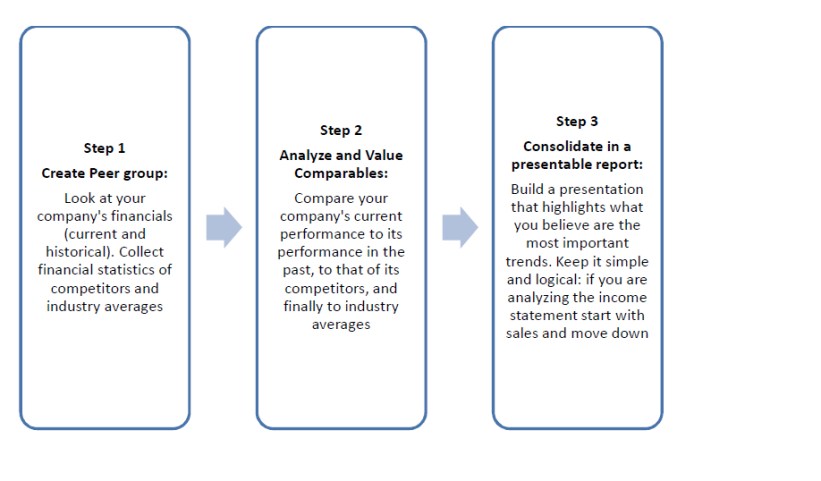
 •Step 1 Create Peer group: Look at your company’s financials (current and historical). Collect financial statistics of competitors and industry averages.

•Step 2 Analyze and Value Comparable: Compare your company’s current performance to its performance in the past, to that of its competitors, and finally to industry averages.

•Step 3 Consolidate in a presentable report: Build a presentation that highlights what you believe are the most important trends. Keep it simple and logical: if you are analyzing the income statement start with sales and move down.

Financial Ratios Presentation