
The purpose of this blog is to explain financial concepts that are insightful, important, and used frequently. As you read through you might disagree with what I say, please let me know if you do. And remember I am offering one point of view. You are free to reject it.
Financial Ratios
My first post will be about Financial Ratios, they seem to be elusive while they are essential, the nightmare of every finance student (as I remember from college), and apparently many people Google them in the UAE. Go to Google trends type “Financial Ratios” look at the section ranking the countries that most frequently search the term; the UAE occupies the fourth place!
Financial ratios are used to analyze trends, a standalone ratio tells very little about a company. You would never hear a worthwhile business person say “I did well this year as my company generated a profit margin of 10%”, what he would say “I did well this year as my company generated a profit margin of 10% compared to 3% last year” or “compared to 5% industry average” or “compared to 8% budgeted for the year”.
The beauty of ratios is that almost all of them can be calculated using the three financial statements: Income Statement, Balance sheet, and Cash Flow Statement.
Although Ratios are often divided into five groups, I suggest not complicating life. Instead let us start with some common facts of financial ratios:
- Most ratios with the term “Margin” have the sales figure in the denominator.
- Most ratios with the term “Turnover” have the sales figure in the numerator, except for Inventory and Account Payables use COGS.
- Most ratios with the term “Return on” have NI in the numerator.
- Most ratios that seem to have a name hinting to their formula are not trying to trick you.
Based on these facts it becomes much easier to remember many of the ratios. Below is a list of some of the common ratios, ones that are not too complicated, and are used often. From them we can also build more complex concepts.
| Should I | memorize | |||
| Ratios | Formula | Yes | No | Use Fact |
| Gross Margin % |
Gross Profit / Sales |
X |
1 |
|
| Operating Margin % | EBIT / Sales |
X |
1 |
|
| Net income Margin % | NI / Sales |
X |
1 |
|
| Return on Equity | NI / Average Equity |
X |
3 |
|
| Return on Investment | NI / Average Investment |
X |
3 |
|
| Return on Assets | NI / Assets |
X |
3 |
|
| Asset Turnover | Sales / Total Assets |
X |
2 |
|
| Inventory Turnover | COGS / Average Inventory |
X |
2 |
|
| Receivables Turnover | Sales / Average Receivables |
X |
2 |
|
| Payables Turnover | COGS / Average Payables |
X |
2 |
|
| Long Term Debt to Equity | Long Term Debt / Equity |
X |
4 |
|
| Enterprise Value to Sales | EV / Sales |
X |
4 |
|
| Enterprise Value to Operating Profit | EV / EBIT |
X |
4 |
|
| Debt to Equity Ratio (Net gearing) | Debt / Equity |
X |
4 |
|
| Return on capital | EBIT (1-T) / Capital |
X |
||
| Efficiency Ratio | Noninterest Expenses / Sales |
X |
||
| Current Ratio | Current Assets / Current Liabilities |
X |
||
| Quick Ratio | (Current Assets-Inventory) / Current Liabilities |
X |
||
| Inventory Turnover period | 365 / Inventory Turnover Ratio |
X |
||
| Receivables Turnover period | 365 / Receivables Turnover Ratio |
X |
||
| Payables Turnover period | 365 / Payables Turnover Ratio |
X |
||
| Cash Conversion Cycle | Inv Turnover Period + A/R Turnover Period -A/P Turnover Period |
X |
||
| Enterprise Value (EV) | NOPAT – [Capital Investments x WACC] |
X |
A few pointers on financial ratios
| Better Higher | or lower | ||
| Ratios | Comment | Higher | Lower |
| Gross Margin % | I want more GP for each sale unit made |
X |
|
| Operating Margin % | I want more of my sales to go into EBIT, after operating expenses are covered |
X |
|
| Net income Margin % | EBIT income is reduced by financing costs to get NI, aim to reduce finance cost |
X |
|
| Return on Equity | The more NI generated from equity capital (investment) the better |
X |
|
| Return on Investment | The more NI generated from investments the better |
X |
|
| Return on Assets | The more NI generated from my assets base the better |
X |
|
| Asset Turnover | Using a fixed asset base I want to produce the largest volume of sales |
X |
|
| Inventory Turnover | Aim to sell most inventory and replace it with new inventory (thus COGS) |
X |
|
| Receivables Turnover | The higher sales are compared to average A/R the more cash sales I have |
X |
|
| Payables Turnover | Higher sales compared to the payables, the more cash I will have |
X |
|
| Long Term Debt to Equity | Depends on chosen company capital structure | ||
| Enterprise Value to Sales | The higher the value of my enterprise compared to sales the better |
X |
|
| Enterprise Value to Operating Profit | The more value I can generate from my profits the better |
X |
|
| Debt to Equity Ratio (Net gearing) | Depends on chosen company capital structure | ||
| Return on capital | I want to generate more income (net of taxes) from my capital base |
X |
|
| Efficiency Ratio | I want more sales compared to my expenses |
X |
|
| Current Ratio | The higher the current assets compared to liabilities the more liquid I am |
X |
|
| Quick Ratio | Higher CA compared to CL, normalizing for industry structure, the more liquid |
X |
|
| Inventory Turnover period | I want to sell inventory, converting it to sales, as soon as possible |
X |
|
| Receivables Turnover period | I want to collect receivables, convert them to sales, as soon as possible |
X |
|
| Payables Turnover period | I want to extend the time period to pay suppliers as long as possible |
X |
|
| Cash Conversion Cycle | Faster to convert cash into inventory, sell that it, and collect A/R the better |
X |
|
| Enterprise Value (EV) | Higher profit compared to cost of capital needed to get that profit the better |
X |
Again remember whether higher or lower a ratio is, it should be taken relevant to a certain average or a past value of that ratio. I believe an example will help better illustrate this point: Company D financials:
| Income Statement | |||
| Period Ending |
2009 |
2008 |
2007 |
| Total Revenue |
61,101,000 |
61,133,000 |
57,420,000 |
| Cost of Revenue |
50,144,000 |
49,462,000 |
47,904,000 |
| Gross Profit |
10,957,000 |
11,671,000 |
9,516,000 |
| Operating Expenses | |||
| Research Development |
663,000 |
610,000 |
498,000 |
| Selling General and Administrative |
7,102,000 |
7,538,000 |
5,948,000 |
| Non Recurring |
2,000 |
83,000 |
– |
| Operating Income or Loss |
3,190,000 |
3,440,000 |
3,070,000 |
| Income From continuing operations | |||
| Total Other Income/Expenses Net |
227,000 |
461,000 |
343,000 |
| Earnings Before Interest And Taxes |
3,417,000 |
3,872,000 |
3,390,000 |
| Interest Expense |
846,000 |
880,000 |
762,000 |
| Income Before Tax |
3,324,000 |
3,827,000 |
3,345,000 |
| Income Tax Expense |
93,000 |
45,000 |
45,000 |
| Minority Interest |
– |
(29,000) |
(23,000) |
| Net Income From Continuing Ops |
2,478,000 |
2,947,000 |
2,583,000 |
| Net Income |
2,478,000 |
2,947,000 |
2,583,000 |
| Balance Sheet | |||
| Period Ending | 2009 | 2008 | 2007 |
| Assets | |||
| Current Assets | |||
| Cash And Cash Equivalents |
8,352,000 |
7,764,000 |
9,546,000 |
| Short Term Investments |
2,452,000 |
208,000 |
752,000 |
| Net Receivables |
4,731,000 |
7,693,000 |
6,152,000 |
| Inventory |
867,000 |
1,180,000 |
660,000 |
| Other Current Assets |
3,749,000 |
3,035,000 |
2,829,000 |
| Total Current Assets |
20,151,000 |
19,880,000 |
19,939,000 |
| Long Term Investments |
954,000 |
1,967,000 |
2,470,000 |
| Property Plant and Equipment |
2,277,000 |
2,668,000 |
2,409,000 |
| Goodwill |
1,737,000 |
1,648,000 |
– |
| Intangible Assets |
724,000 |
780,000 |
– |
| Accumulated Amortization | – | – | – |
| Other Assets |
657,000 |
618,000 |
817,000 |
| Deferred Long Term Asset Charges | – | – | – |
| Total Assets |
26,500,000 |
27,561,000 |
25,635,000 |
| Liabilities |
|
||
| Current Liabilities | |||
| Accounts Payable |
8,315,000 |
11,591,000 |
12,432,000 |
| Short/Current Long Term Debt |
113,000 |
225,000 |
188,000 |
| Other Current Liabilities |
6,431,000 |
6,710,000 |
5,171,000 |
| Total Current Liabilities |
14,859,000 |
18,526,000 |
17,791,000 |
| Long Term Debt |
1,898,000 |
362,000 |
569,000 |
| Other Liabilities |
2,472,000 |
2,070,000 |
647,000 |
| Deferred Long Term Liability Charges |
3,000,000 |
2,774,000 |
2,189,000 |
| Total Liabilities |
22,229,000 |
23,732,000 |
21,196,000 |
| Stock Holder’s Equity | |||
| Misc Stocks Options Warrants | – | – | – |
| Redeemable Preferred Stock | – |
94,000 |
111,000 |
| Preferred Stock | – | – | – |
| Common Stock |
11,189,000 |
10,589,000 |
10,107,000 |
| Retained Earnings |
20,677,000 |
18,199,000 |
15,282,000 |
| Treasury Stock |
(27,904,000) |
(25,037,000) |
(21,033,000) |
| Capital Surplus | – | – | – |
| Other Stockholder Equity |
309,000 |
(16,000) |
(28,000) |
| Total Stockholder Equity |
4,271,000 |
3,735,000 |
4,328,000 |
Profit analysis:
- The gross profit margin grew from 16.5% in 2007 to 19% in 2008 and then fell to 18% in 2009. (Why?) Between 2007 and 2008 revenue grew by 6.5% compared to a 3.3% growth of COGS. While between 2008 and 2009 revenue stayed almost unchanged but COGS grew by 1.4%.
Now that we stated the facts, the next step would be to understand what caused this trend of growth, why did the revenue grow faster than the COGS in 2008 but not in 2009? There could be several reasons, but all of them would logically have one thing in common: “In 2008 D was selling a higher margin product than in 2009”. Thus one should look at the margins of the 2008 product mix and compare it to 2009 to first see which are the higher margin products, then investigate further why do they have a higher margin? Is it because company D is the only supplier of this product and can charge a high price? Does the company have a strong position with suppliers, when it comes to this product, and can negotiate better?
- The operating income (EBIT) margin was 5.3% in 2007, grows very little to 5.6% in 2008, and then falls to 5.2% in 2009. The EBIT margin remains around 5% even though there were changes in the gross profit margin between 2007 and 2009, due to the trend that the Selling and Administrative (S&AD) expenses as a percent of sales followed within the two years period (between the GP and EBIT lines the largest expense is the S&AD which logically means it is the expense influencing the EBIT most). As a matter of fact looking at the S&AD expense as a percent of sales, it grows from 10.4% in 2007 to 12.3% in 2008, when GP margin grew from 16.5% to 19%.
- The NI margin is approximately 4.8% all three years. Although the sales grew, and our GP margin increased. The NI margin did not change much due to EBIT margin and interest as a percent of sales changing very little (interest expense as a percent of sale grew very little).
- Conclusion: The growth in sales between 2007 and 2008, which helped company D acquire a larger market share came about by increasing the S&AD expenses, most likely by hiring new employees or resources, and by using loans to fund growth. The interest expense as a percentage of sales grew as D loans increased (check the balance sheet Long Term Debt). Note: If you check whether the above balance sheet tallies (confirm the Balance sheet formula Assets = Liabilities + Equity), it will not tally. This is because of the Redeemable Preferred Stock which you should add to Equity while calculating the Balance sheet formula.
You would continue analyzing the financial statements using the ratios in the same manner.
Start (as my Boss always recommends) by building a common size income statement (divide everything by the revenue), apply the ratios of the normal statements; and then look for trends and growth patterns. It is easy if you move from one line to the next on the financial statements, as every total is determined by what is above it. The change in the NI is a summary of the changes in the EBIT and the GP, the change in the Total Assets is a summary of the changes in the Long term and Short Term assets, and so on.
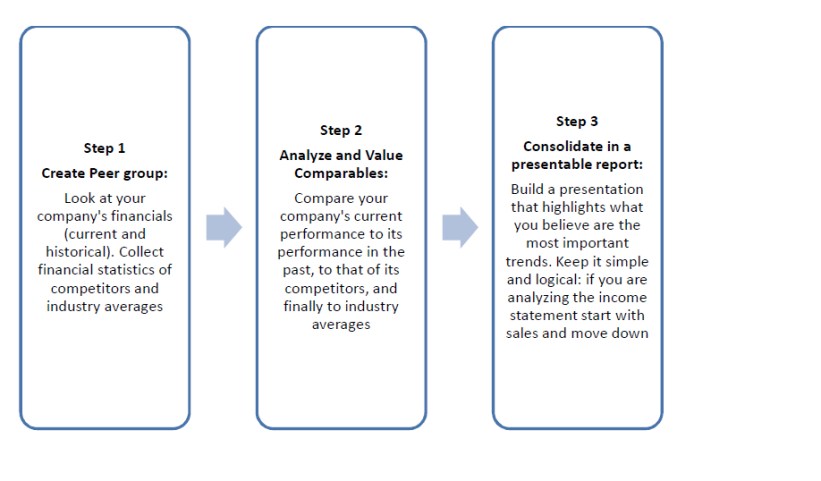
•Step 1 Create Peer group: Look at your company’s financials (current and historical). Collect financial statistics of competitors and industry averages.
•Step 2 Analyze and Value Comparable: Compare your company’s current performance to its performance in the past, to that of its competitors, and finally to industry averages.
•Step 3 Consolidate in a presentable report: Build a presentation that highlights what you believe are the most important trends. Keep it simple and logical: if you are analyzing the income statement start with sales and move down.
 Waelsasso's Blog
One thought on “How to deal with those Financial Ratios?”